
Pakistan military spokesperson Lieutenant General Ahmad Sharif Chaudhry told a hurriedly called press conference in Islamabad at around 4 am that th Pakistan air force's Nur Khan (Chaklala, Rawalpindi), Murid (Chakwal) and Rafiqui (Shorkot in Jhang district) airbases were targeted.

The ministry of external affairs said in a statement that the Indian embassy remains in touch with the community with a view to extend all feasible assistance.
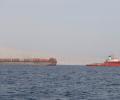
US strikes on Iran's three main nuclear facilities have once again raised concerns that Tehran might shut down the Strait of Hormuz - one of the world's most critical chokepoints, through which a fifth of global oil and gas supply flows.

It is learnt that Russia is not sending any military platform to exercise and there is no clarity yet on whether it will depute any delegation for the event.

Top government officials in New Delhi have started discussions with stakeholders ranging from shipping and container companies to export promotion councils to understand the impact of the Iran-Israel tensions and plan ahead. Inter-ministerial talks are also being lined up amid the crisis situation in West Asia, sources confirmed. While the crude flows are not directly under any threat, elevated oil prices remain a concern, according to officials.

Four-nation grouping Quad on Tuesday launched a major new initiative for the Indo-Pacific that allows the partner countries to fully monitor the waters on their shores and help ensure peace and stability in the region, a move that comes amid China's increasingly intimidatory behaviour.
The 'mediation' by the United States from behind the scene on the diplomatic track appears to be once again working, which calls on both Delhi and Islamabad to show restraint and pull back from a military confrontation, notes Ambassador M K Bhadrakumar.
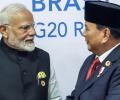
India is trying hard to erase Indonesia's wariness about New Delhi, building security cooperation in the Indian Ocean and Pacific Ocean. If Indonesia decides to buy the Brahmos missile, it would further strengthen relations between the world's most populous nation and the most populous Islamic country.
Trump's sweeping tariffs and penalties on China-built ships have turned global shipping into the front line of economic war, observes Shyam G Menon.
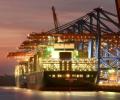
A year after a Hamas attack against Israel on October 7 and the ensuing Israeli invasion of the Gaza Strip, India's trade with most West Asian countries has largely escaped any major disruption, except with countries like Israel, Lebanon, and Jordan. However, repeated flare-ups of geopolitical tensions in the region continue to drive up shipping and logistics costs.

The Quad also vowed to work towards a free, open and prosperous Indo-Pacific, a region that has seen increasing Chinese military muscle-flexing in the last few years.

Sources are in touch with Iranian authorities through diplomatic channels, both in Tehran and in Delhi.
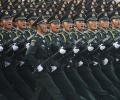
In a surprise development, a top Chinese military general has cast aspersions on the People's Liberation Army (PLA)'s much-publicised 'real combat-oriented exercises' as 'fake combat capabilities' at a time when Chinese President Xi Jinping has ordered it to prepare for 'maritime military struggles' to win wars.

Prime Minister Narendra Modi has said that the Quad is not against anyone, but for a rules-based international order and respect for sovereignty, in a veiled reference to China.

The Indian Navy said warships and aircraft were deployed to establish presence, provide a sense of reassurance to the Indian merchant men

India and China have made "some progress" in disengagement, External Affairs Minister S Jaishankar said on Sunday, describing it as a "welcome" move which opens up the possibility that other steps could happen.

Tensions between China and Japan over disputed islands in the East China Sea intensified on Tuesday after two armed Chinese maritime vessels reached close to the area protected heavily by the Japanese coast guard.
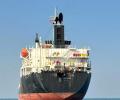
The world needs to wake up to this new dimension of war at sea and be prepared to face the 'unknown enemy' who have the advantage of attacking at their choice of location and time, cautions Commodore Venugopal Menon (retd).
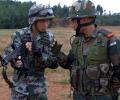
The statement of Commander of US Indo-Pacific Command Admiral John Aquilino on Wednesday came ahead of the 15th round of high-level military talks between India and China on March 11.
Amid escalation of maritime tensions with neighbours and a US military focus shift to Asia Pacific, Chinese military is stepping up its conventional missile capability, polishing its ability to carry out multiplelaunches while preserving its strategic nuclear deterrence.

In a year bookended by intractable conflicts and geopolitical fragmentation, India focused on ramping up military prowess by broadly firming up defence procurement worth Rs 4.22 lakh crore even as Indian and Chinese militaries completed pulling back their troops from border face-off points in eastern Ladakh.
China's first aircraft carrier has commenced its second sea trials in the Pacific Ocean to test its deck for fighter landings as well to check its weapons systems, ahead of its likely deployment next year.
In a surprise move China's State Oceanic Administration (SOA) announced that a maritime surveillance fleet consisting of two patrol vessels, Haijian 50 and Haijian 66 started patrolling the waters of the Diaoyu Islands since Friday

No such decision has been taken either in the Indian Ocean or South China Sea.
Seven Chinese warships, including two destroyers, were sighted on Tuesday in waters off a Japanese island, according to the defence ministry, as tension mounted between the two Asian giants over territorial disputes. The naval ships passed the contiguous zone, a band of water just outside Japan's territorial waters, which are governed by international maritime law.
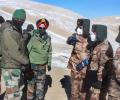
Lou also spoke about China's tensions with neighbouring countries without directly mentioning the eastern Ladakh border standoff with India since May 2020 which resulted in the Galwan Valley clash in June of that year.

The eastern theatre command of the Chinese People's Liberation Army successfully completed all tasks of its combat readiness patrols and exercises around Taiwan Island, official media in Beijing reported.

The Indian Navy, which regards itself as the 'net security provider' in the Indian Ocean Region, has also stepped up to the plate, with a warship stationed at all times off the Gulf of Aden for counter-piracy tasks. 91 Indian warships have been deployed in the region since 2008, patrolling high risk areas where piracy was rampant.

Shigeru Ishiba is expected to prioritise strengthening Japan's military capabilities and fostering deeper international partnerships, particularly with India, with whom Japan shares significant strategic interests, explains Dr Rajaram Panda.

The US President also discussed the ongoing efforts to secure the release of all remaining hostages under Hamas captivity and reviewed the situation in Gaza.

The trigger that led Japan and the Philippines to ink the deal was because of the deteriorating security situation in the South China Sea. China's coast guard increased the frequency and intensity of incursions into Philippine waters, provoking the Philippines to take countermeasures to deter China, explains Dr Rajaram Panda.

The Chinese navy has kicked off 10-day military exercises in the disputed South China Sea amid heightened tensions in the region, especially with the United States.
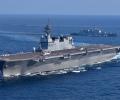
Here are some of the glimpses of the exercise held in the North Arabian Sea.

Quoting from the epic Mahabharata and Nobel laureate Rabindranath Tagore, a top Chinese leader has said the easing of tensions between India and Pakistan has increased the prospects of peace in South Asia.

The top diplomats of Quad nations on Friday denounced as "inadmissible" any use or threat of use of nuclear weapons in the Ukraine war and strongly opposed any "unilateral actions" that seek to change the status quo in the South and East China Seas, a region that has witnessed increasing Chinese military offensive.

Prime Minister Narendra Modi said on Sunday said he views the current situation in Ukraine as an issue of humanity and human values and not of politics or economy even as he called for respecting international law, sovereignty and territorial integrity of all nations.
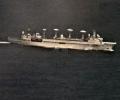
The Chinese research vessel returned to China a few days ago after being under constant watch of Indian Navy vessels, the sources said.

The annual threat assessment of the US Intelligence Community released by the Office of Director of National Intelligence (ODNI) also said that the 'expanded military posture by both India and China along the disputed border elevates the risk of armed confrontation between two nuclear powers that might involve direct threats to US persons and interests and calls for US intervention'.

US State Department spokesperson Morgan Ortagus on Sunday said five years ago on September 25, 2015 the Chinese President, standing in the White House Rose Garden, promised 'China does not intend to pursue militarisation' of the Spratly Islands, and China's outposts 'would not target or impact any country'.

'These tactics are particularly evident in China's pursuit of its territorial and maritime claims in the South and East China Seas as well as along its border with India and Bhutan'
